
RADC
Research and Development Credit
MADIBA Development Aid

Financial aid division for program funding
About RADC
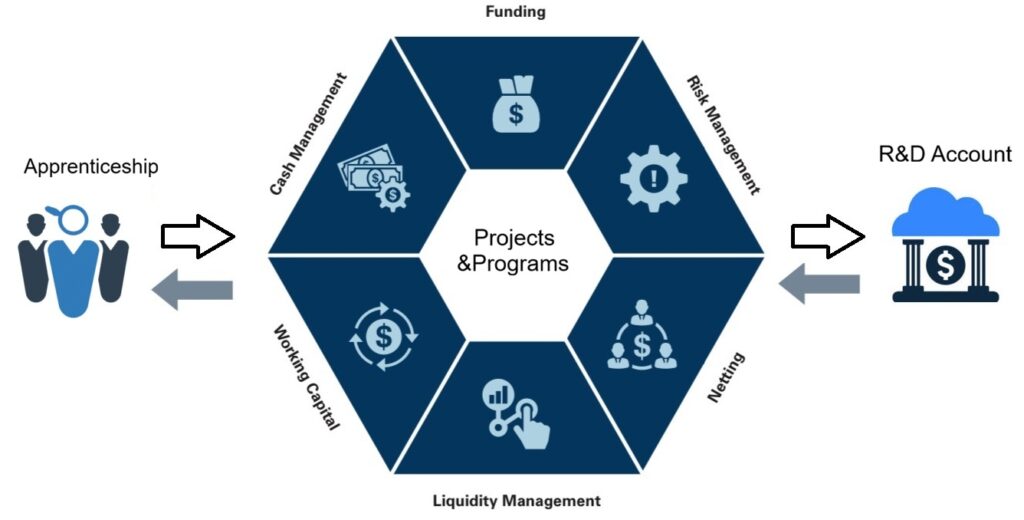
RADC is members financial aid for program funding—including stock grants, scholarships, work-study, for credit facility —designed to help fund Research and Development program.
R&D Stock Grants and Scholarships: This is a “Ownership Gift” to members that does not have to be paid back. These are awarded based on members portfolio, program need, academic merit, or specific talents.
Work-Study: This is a work for hire obligation for members that allow them to earn money by earning credit through R&D performance to help pay for educational program expenses.
R&D Credit This is credit facility leverage for stock grant allocation that yield interest repayment only from the investment program market performance
- Credit facilities offer members flexibility by allowing them to working capital only as needed, rather than receiving a lump sum up front like traditional loans.
- Apprentices and Sponsors can choose from several types of credit facility arrangements including sponsorship bond, committed facilities, commercial paper, and letters of credit, each providing different benefits and constraints.
- Engaging with credit facilities can enhance members financial reputation and credit rating, but it often involves R&B requirements and fees.
- The conditions of credit facilities are influenced by the apprentice’s financial health, credit history, and program planning structure for R&D Tax Credit guarantee often including covenants and legal obligations that must be adhered to IRS.
- R&D Credit facilities can be advantageous for apprentices managing operational cash flow and strategic expansion while potentially acting as a financial buffer in R&D expenses.
Understanding the Mechanics of RADC
RADC is in conjunction with an apprentice equity financing or raising money by selling shares of their stock.
A key consideration for any academic program is how it will incorporate debt in its capital structure while considering the parameters of its equity financing.
Members can secure RADC with capital asset collateral that can be sold or swapped without changing contract terms. The RADC may apply to different projects or business and be distributed at the member’s discretion. The period for repaying RADC is flexible and, like other methods, depends on the credit situation of the member and how well it has paid off debts in the past.
The summary of a RADC can be used as risk cushion that includes a brief discussion of the collateral and R&D proposal, pro forma, origin, the purpose of the credit, and how funds are distributed as a specific conditions for the intermediary banks sponsoring.
For example, statements of R&D collateral for or particular member responsibilities may be discussed.
Key Components of a RADC Agreement
A RADC agreement outlines members duties, obligation terms, including amounts, rates, duration, and penalties. The contract opens with the basic contact information for each of the parties involved, followed by a summary and definition of the RADC itself.
Funding the RADC: Because Treasury Bank Portal cannot take deposits, but as a captives it typically fund its own credit operations by issuing commercial paper or borrowing from parent companies, commercial banks, or private credit funds.
Commercial/Dealer Financing: Treasury Banking provide inventory financing (floor planning) and wholesale credit facilities to dealerships or commercial buyers so they can stock the parent company’s products.
Vendor/B2B Leasing: MADIBA offer direct working capital lines to apprentice program for purchasing large-ticket items from the parent corporation.
Research and Development (R&D) funding is private credit and tax credit that is a lucrative private and federal incentive that allows MADIBA members as proprietors to offset their income or payroll taxes on a dollar-for-dollar basis. It provides cash savings of 5% to 15% of members qualified research expenses, such as employee wages, contractor costs, and supplies.
How Does Members Qualify?
To be eligible for the RADC and federal R&D tax credit, your activities must pass the IRS’s “Four-Part Test”:
RADC
- MADIBA369 Registration
- Employment Contract
- Performance Agreement
- Actually Active Project
- Banking Channels
- Bookkeeping & Audits
R&D Tax Credit
- Permitted Purpose: The academic activity must relate to developing or improving a new or existing business component (e.g., product, process, formula, technique, or software).
- Technological in Nature: The development must rely on hard sciences, such as engineering, computer science, biology, or physics.
- Elimination of Uncertainty: Members must have faced a technological uncertainty regarding the capability, methodology, or design of the business component at the outset.
- Process of Experimentation: Members must have evaluated alternatives or employed systematic trial-and-error to overcome the technological uncertainties.
Eligible R&D Expenses
If developers activities qualify, they can claim the following as Qualified Research Expenses (QREs):
- Wages: Gross wages for members directly conducting, supervising, or supporting the qualified research.
- Supplies: Tangible property consumed during the R&D process (e.g., raw materials for prototypes).
- Contractor Costs: Payments to third parties (e.g., independent engineers, external labs) for conducting research on your behalf, typically when you retain the economic risk.
- Cloud & Software: Costs for leasing cloud computers or servers used directly in the R&D process.
How to Claim Tax Credit
For Profitable Member: The credit directly offsets your members income tax liability on a dollar-for-dollar basis. Unused credits can generally be carried forward for up to 20 years.
For Startup Members: If members has gross receipts under $5 million and is under 5 years old, you can use the Payroll Tax Credit to offset up to $500,000 of your employer-paid FICA and Medicare payroll taxes.
Form 6765: The credit is figured and claimed by filing IRS Form 6765 with members annual tax return. Members can also file amended returns for the last 3 open tax years to claim retroactive refunds